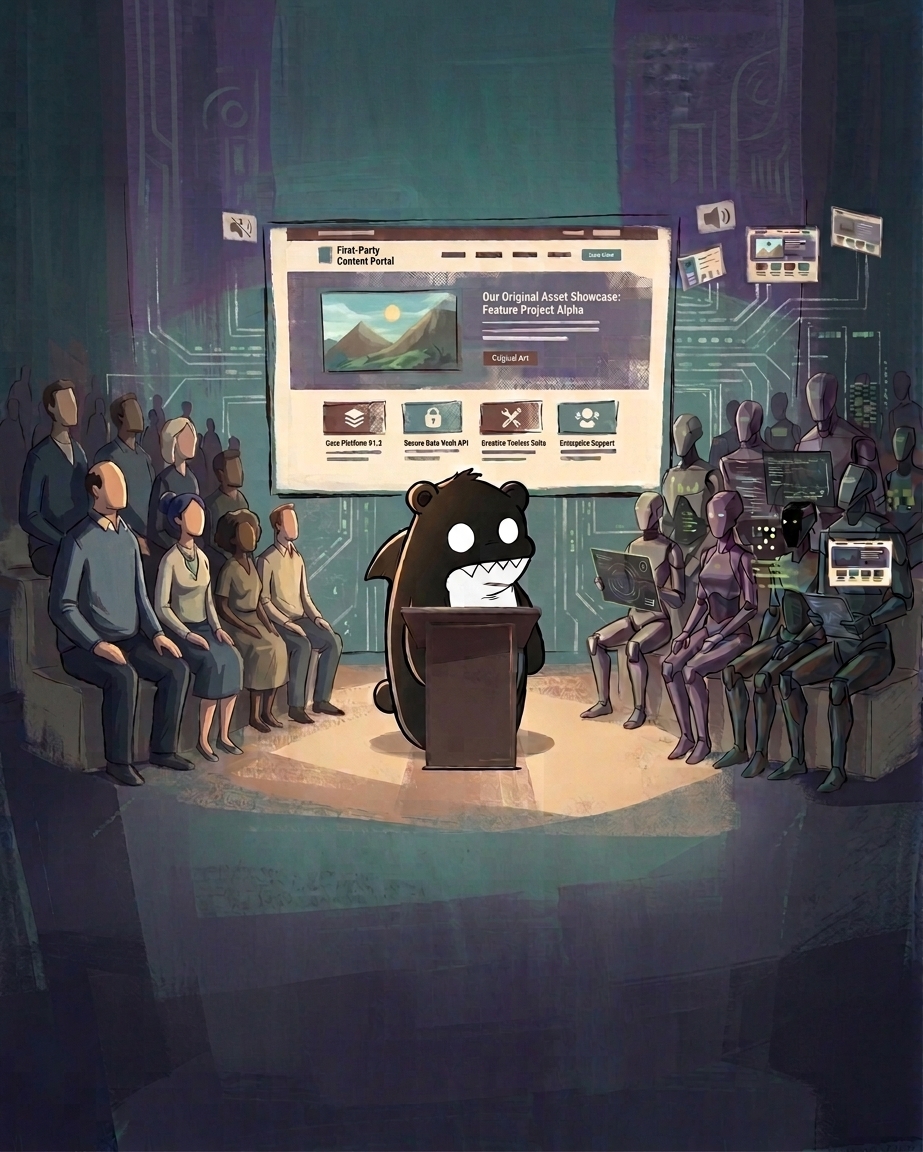
AI Agents as an Audience (AAaaA)
I’m kidding about AAaaA, but I’m not kidding about the premise here. AI agents should be segmented as a separate audience.
The last two decades we’ve spent looking at various behavior analytics and the audience has been primarily human. For the most part, we understand how to read a human visitor. We watch how far they scroll before they give up. We know if they bounced in four seconds or what page they clicked on next. And if I was betting on Kalshi, I’d bet that you’re running at least three versions of a CTA right now to see which one performs the best in getting them to fill out your form.
But AI agents aren’t human so we shouldn’t expect the same behaviors, motivation, and consumption to be the same as your other audience.
And to be honest, it gives me the ick to have to say “your human audience” vs. “your AI agent audience” but when I would meet with marketers, it was the audience analogy that provided the “ooohhhh, now I understand why this matters” reaction.
Yes, the agents are likely searching on behalf of a human, but the AI agent is fulfilling a task to research a category, recommend a solution, and synthesize information for the most likely desired response. Perhaps content from your website is a part of it, maybe some review sites, or your competitor’s pages or thirty other sources contributed to the response returned in seconds. But from your marketing analytics standpoint, you don’t get scroll depth, a bounce metric, or know the exact path it took to and from your site. Every instrument you've built to understand lives in a black box that you don’t have access to.
AI chat is a channel but AI agents are an audience
What we’ve done is treat AI as another channel to reach our audience. Email, social, paid ads, and now AI chat. So the tactics for SEO got modified with a new acronym (GEO/AISEO/AEO — pick your fave) so you can reach your human audience (again, ick). In this scenario, we’ve assumed that the audience is human so the tactics were adjusted for the channel. They were not adjusted for the AI agent audience.
This means that you are inheriting assumptions of behaviors and traits that AI agents don’t possess. Someone asking AI to compare vendors isn't reading all the responses themselves. The agent’s motivation is to execute a task and return an output that it can trust (don’t come at me about hallucinations) after looking for multiple sources and most likely what the person wants within seconds. The behaviors, characteristics, and motivations are not 1:1.
Listen, we haven’t had to deal with grasping what this means so the AI agent audience segmentation probably hasn’t been accounted for. The AI agents arrived through a new channel that has been quickly adopted unlike any channel we’ve ever seen. So brands quickly responded to the channel. Get cited, surfaced, and recommended was the goal, but we didn’t stop to ask “who’s asking and how should the information be delivered.”
Why it matters
This isn't a future problem. Discovery and evaluation are already routing through agents today (check out Cloudflare’s AI Insights to see AI traffic by bot and purpose), in numbers that grow every quarter, and most companies have done little work to find out what those agents currently believe about them. You could be losing comparisons you never knew were happening, to competitors you're not tracking, decided by criteria you didn’t realize that AI agents selected.
How this looks
Take a company with a clean, professional-looking website that has great design, confident copy, a homepage that says exactly what a visitor needs to hear.
But then an AI agent is tasked to research that same company, and it comes back with something closer to confusion than confidence. The company homepage mentions one set of services, but the agent found a case study from two years ago that describes a different focus entirely. A blog post claims a specialty the homepage never mentions. It’s unlikely a human visitor would notice this or read all the details on the homepage, find an outdated case study, and a blog post in the same sitting. But the agent does, because reading everything at once is exactly what it does. Instead of one clear story, it finds three, and it either flags the company as inconsistent or just runs with whichever version showed up most and maybe it’s not the version that the company wants.
That's the two audiences, side by side. The human never got past the homepage and decided this looked trustworthy. The agent read everything on the homepage, checked several additional sources, found contradictions, and that reduced confidence in the company.
So what now
I'm not telling you to rebuild your website just for robots (yet). I'm telling you that you've got an audience that is sitting inside your traffic and should be segmented out and approached with understanding of what that means.
The AI agent audience asks different questions, judges you by different criteria, and decides whether you're worth recommending using a process you've never looked at. Meanwhile you're still tuning CTA copy for the human on the other end (still do this) and calling it done (don’t do this). Both matter.
If you're wondering whether you're already losing ground here, what AI believes about your brand today, or you just want to assess your AI agent readiness, hit me up. I'll tell you where you actually stand.